
A GRC SaaS closes 55 prioritized risks with a hub-and-spoke move on AWS
 Amazon EKS
 Amazon RDS
 AWS Organizations
 Well-Architected Tool
Shared anonymously — the customer’s name is held by VeUP and available on request.
A security-first SaaS provider asked the hard question of its own platform: how much risk had organic growth quietly accumulated? VeUP ran a six-pillar AWS Well-Architected Review across ~60 customer environments on Amazon EKS and RDS — and came back with 55 prioritized risks, a ~$600/month cost leak, and a five-move remediation roadmap toward a multi-account, hub-and-spoke target state.
The challenge
The platform had grown the way successful platforms do — one customer environment at a time, ~60 of them, all inside a single AWS account. That meant one compromise could reach every customer. The root account had no MFA. Every EC2 instance carried a public IP, with no NAT Gateways — a wider attack surface and an avoidable IPv4 bill. Observability stopped at Route 53 health checks and manual error review; recovery meant nightly snapshots restored customer by customer, by hand, with a 24-hour RPO; OS patching was manual just as AWS Inspector Classic headed for retirement.
For a company that sells governance, risk, and compliance software, the ask was fitting: an objective, prioritized read of its own risk — across security, resilience, cost, and operations.
The solution
VeUP ran the full Well-Architected Review — all six pillars, stakeholder interviews paired with hands-on scoring — and turned the findings into a roadmap ranked by what would hurt most if left alone. Five moves lead it:
- Hardware MFA on root, then multi-account isolation via AWS Organizations
- Hub-and-spoke network; instances into private subnets behind central NAT egress
- CloudWatch metric filters and one fleet-wide dashboard
- Automated restoration plus cross-region snapshot copies
- Patch Manager automation before Inspector Classic retires
The review also gave credit where it was due: a CI/CD pipeline with dry-run security checks, broad Multi-AZ coverage, and managed Amazon EKS and RDS were strengths worth building on, not rebuilding.
Architecture
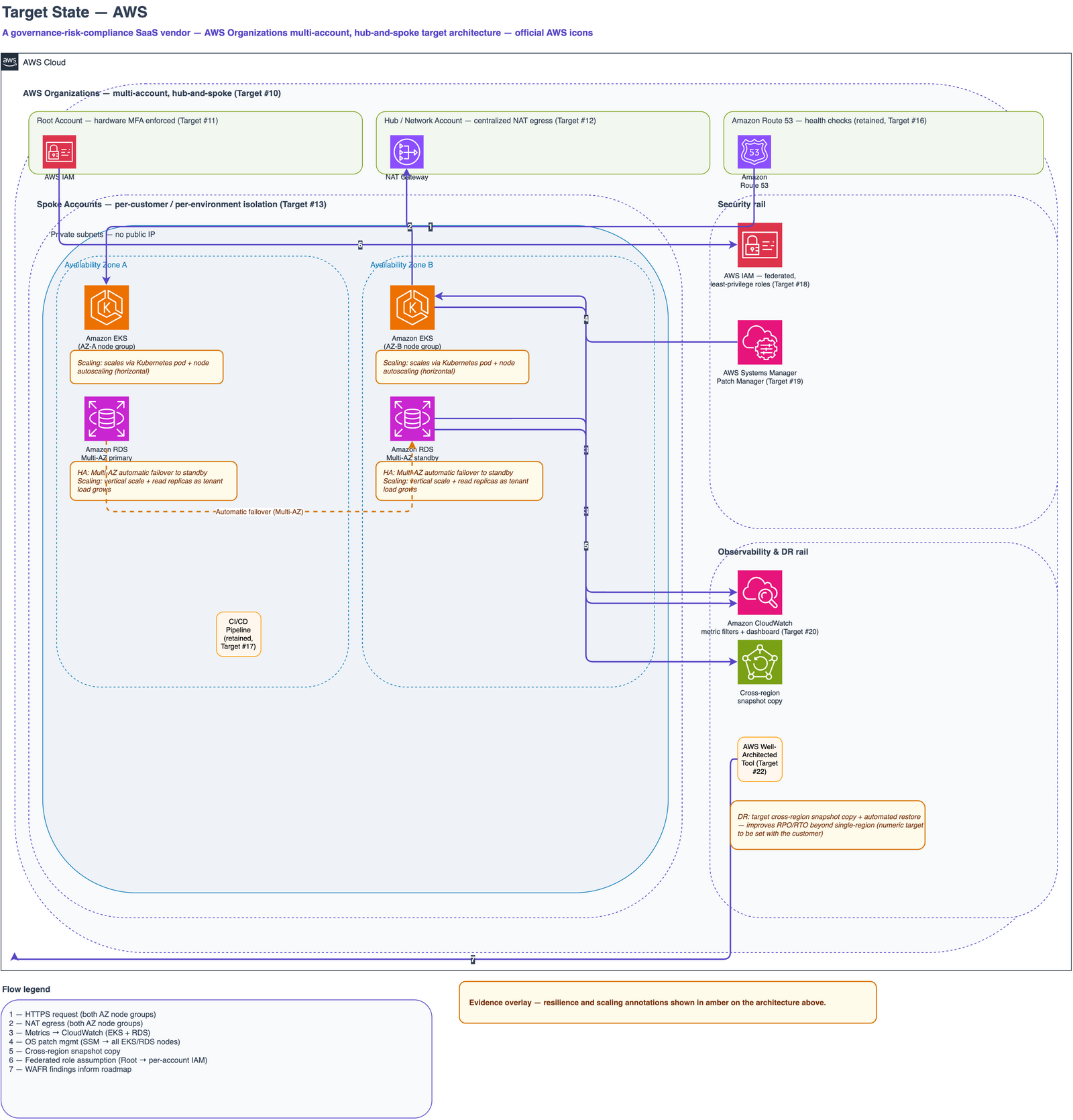
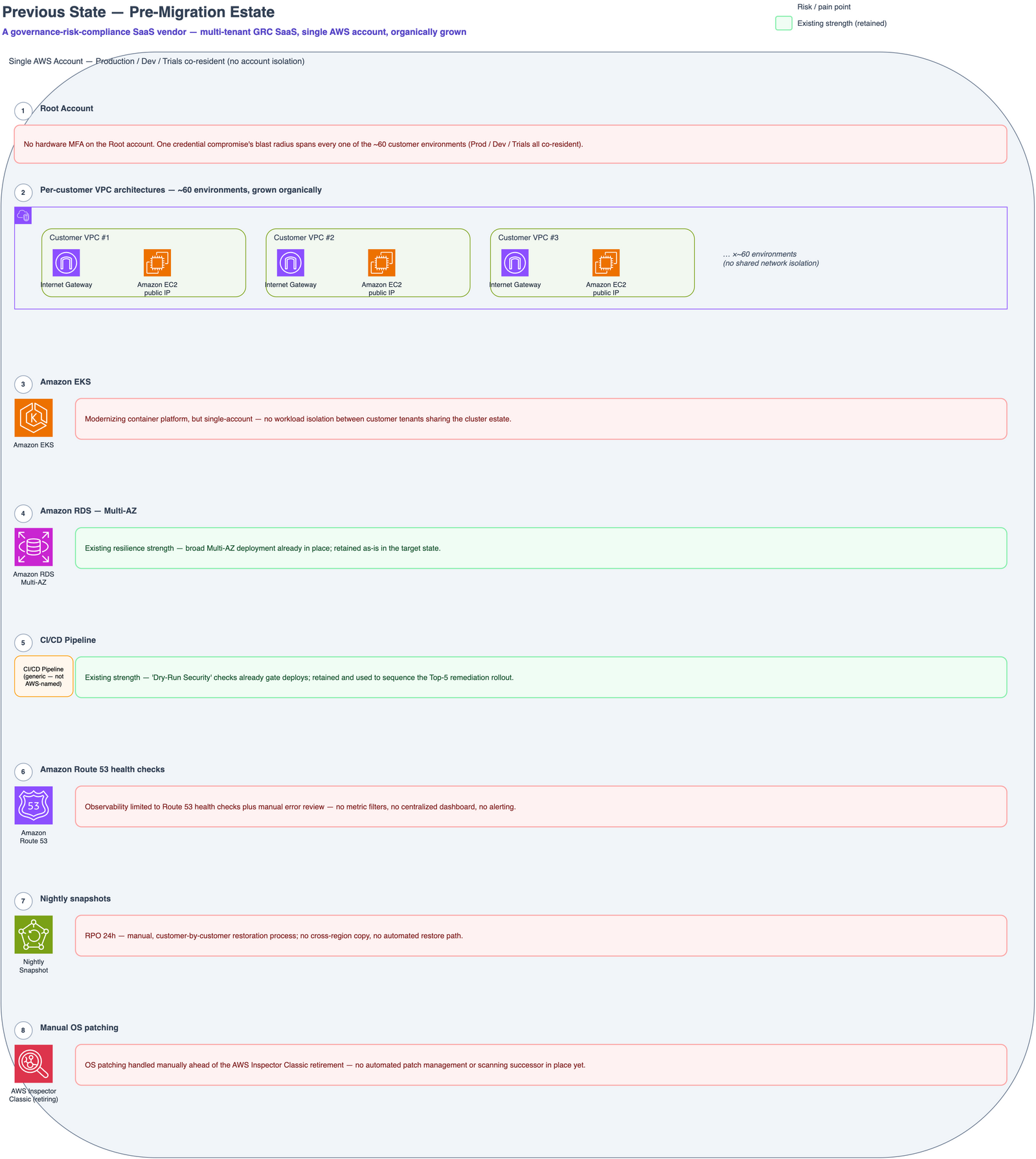
What the review surfaced, pillar by pillar:
- Hardware MFA on root; AWS Organizations isolation
- Private subnets only — no public instance IPs
- Federated IAM, no shared credentials
- Cross-region snapshot copies with automated restore
- RDS Multi-AZ retained as an existing strength
- CI/CD dry-run checks gate the remediation sequence
- CloudWatch metric filters and a fleet-wide dashboard
- Top-5 roadmap run as a sequenced runbook
- Patch Manager automation
Production outcomes
| KPI | Result |
|---|---|
| Review outcomes | All six pillars assessed and risk-rated. 55 prioritized risks — 39 High, 16 Medium — each paired with a concrete fix. Security, Reliability, Cost, Operations, and Performance came back High-risk; Sustainability Medium. A ~$600/month avoidable IPv4 cost surfaced with a clear elimination path, and the Top-5 roadmap ranks every move by business impact against effort. |
| Timeline | A focused review in February 2026, executive summary in the customer’s hands the same day. Remediation is now the customer’s forward roadmap. |
| Cost posture | The Cost Optimization pillar found ~$600/month of avoidable IPv4 spend — every EC2 instance public-IP’d, no NAT Gateways — and the hub-and-spoke redesign eliminates it while shrinking the attack surface in the same move. |
| Lessons & continuation | Single-account multi-tenancy is the dominant structural risk for an organically-grown GRC SaaS — multi-account isolation and Root MFA lead the roadmap; a hub-and-spoke / NAT Gateway egress redesign closes attack surface and removes IPv4 cost in one move; sequence remediation by business impact and effort so a security-first customer can act immediately. |
 Amazon EC2
 Amazon VPC
 NAT Gateway
 Amazon CloudWatch
 AWS Systems Manager
 Amazon Route 53
 AWS IAM