

Shipium maps the path to proven multi-region DR on Amazon EKS with an AWS Well-Architected Review
 Amazon EKS
 Aurora Global DB
 AWS FIS
 Route 53
VeUP delivered a six-pillar AWS Well-Architected Review of Shipium's active-active, two-Region SaaS shipping platform on Amazon EKS, surfaced 7 owner-assigned High-Risk Issues with a 30-60-90 roadmap, and engineered an AWS Fault Injection Service game-day plan to prove disaster recovery cross-region.
The challenge
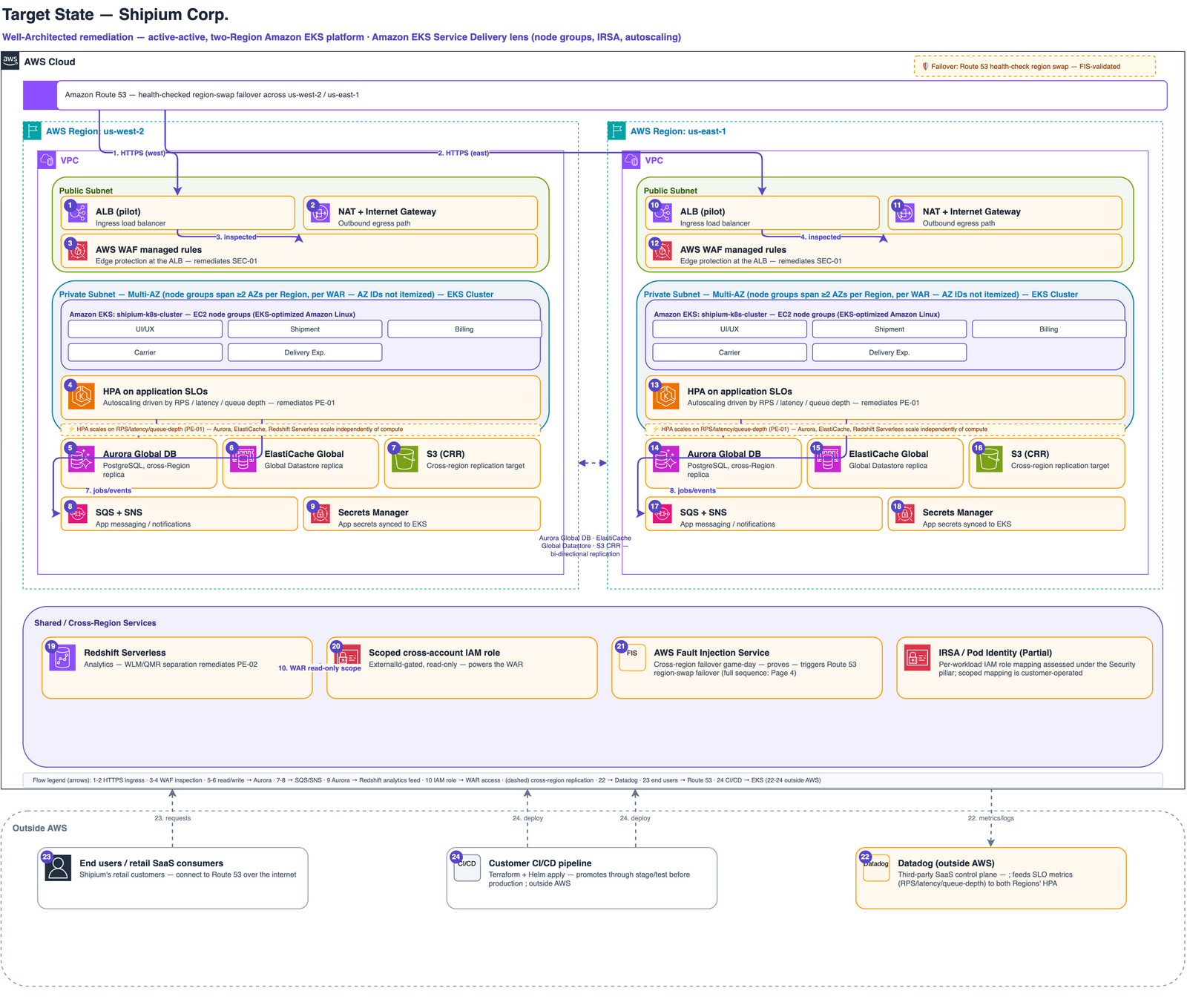
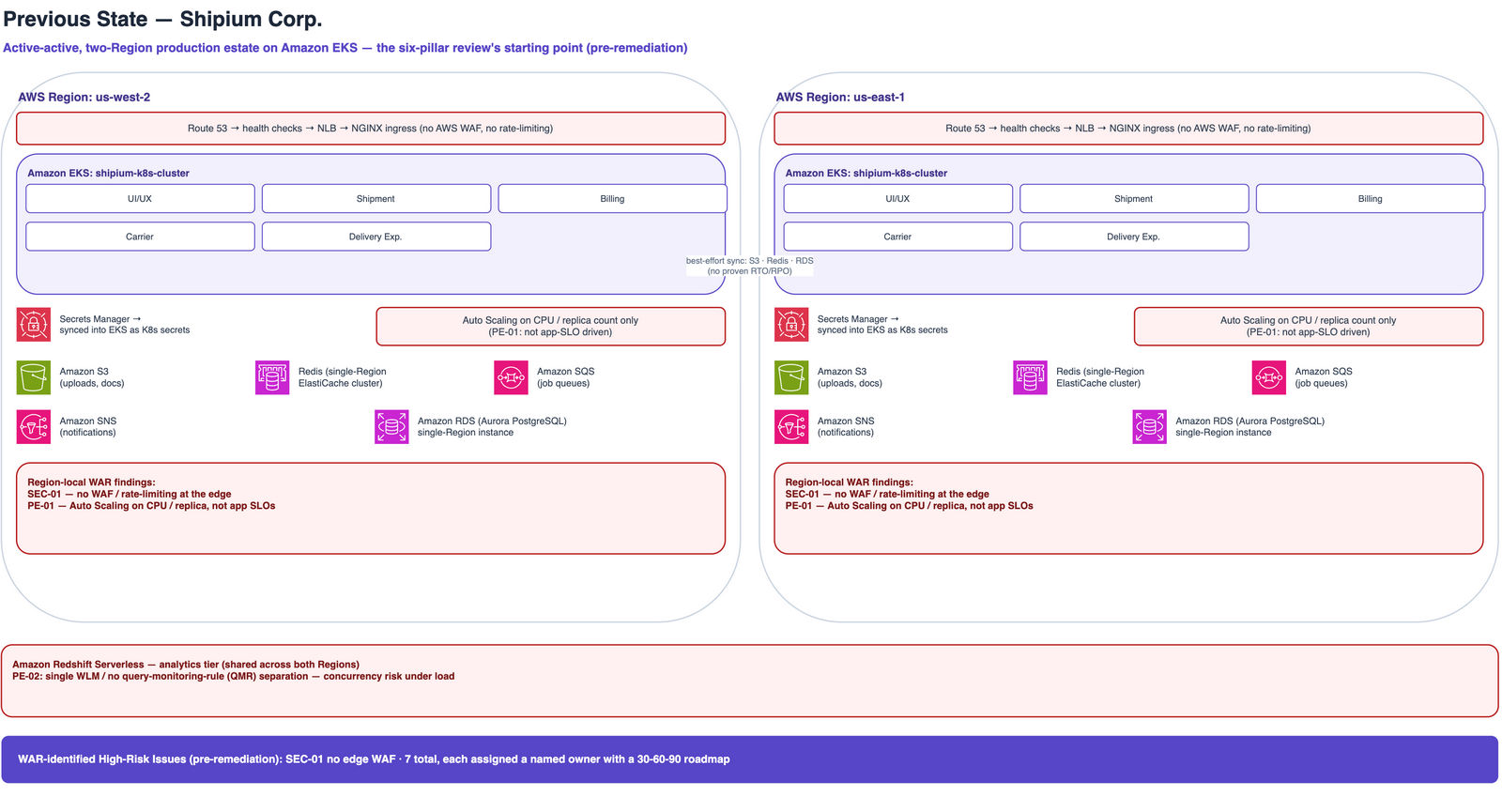
Shipium runs a high-throughput, container-native shipping platform across two AWS Regions on mature Amazon EKS clusters with strong observability. As it scaled, the team needed an independent, structured assessment to surface the gaps engineering velocity outruns — edge protection at ingress, provable disaster recovery, autoscaling driven by application behavior rather than raw CPU, and resilience in the analytics tier — with a prioritized, owner-assigned remediation plan, not just a checklist.
The solution
A full six-pillar AWS Well-Architected Review consolidated in the AWS Well-Architected Tool through a scoped, ExternalId-gated read-only cross-account IAM role, producing a prioritized High-Risk Issue register and a sequenced 30-60-90 roadmap. VeUP then engineered the resilience test plan with AWS Fault Injection Service, scoping cross-region failover game-days against the active-active architecture: Amazon EKS in both Regions (Terraform + Helm), Amazon Aurora PostgreSQL Global Database, Amazon S3 cross-region replication, Amazon ElastiCache global datastores, Amazon Route 53 region swap, and Amazon Redshift Serverless analytics. Representative remediations: piloting an ALB with AWS WAF managed rules at the edge, moving HPA onto application SLOs (RPS, latency, queue depth), and separating analytics via Redshift WLM/QMR. A managed FinOps review surfaced Savings Plans and commitment opportunities across Aurora, ElastiCache, and compute.
Production outcomes
| KPI | Result |
|---|---|
| Production outcomes | A complete six-pillar Well-Architected Review, run against the live production workload through scoped cross-account access. Seven High-Risk Issues surfaced and prioritized, each assigned to a named customer owner with a remediation timeline, on a sequenced 30-60-90 day roadmap that separates quick wins from larger programs. And a concrete path to proven disaster recovery: AWS Fault Injection Service game-day scenarios define a timed Region-impairment test and Route 53 failover against the active-active EKS architecture. |
| Engagement window | The Well-Architected Review was delivered at the end of September 2025, with remediations underway and the engagement ongoing. |
| Cost / TCO posture | A managed FinOps review surfaced Savings Plans and commitment opportunities across Amazon RDS/Aurora, ElastiCache, and compute (top spend: RDS, then compute, then caching; resources split across Oregon and Virginia). The savings sit on Shipium's roadmap as recommendations — not claimed outcomes. |
| Lessons & continuation | Provable DR beats documented DR — FIS game-days turn an RTO/RPO target into evidence; autoscaling on application SLOs (RPS/latency/queue depth) tracks real demand far better than raw CPU; edge protection (WAF managed rules) belongs in front of an ingress that previously had none. |
 Amazon S3 cross-region replication
 Amazon ElastiCache
 Amazon Redshift Serverless
 AWS WAF
Architecture
The Well-Architected Review charts Shipium's path from an unprotected NLB/NGINX edge and CPU-based autoscaling to an ALB + AWS WAF edge, SLO-driven autoscaling, and isolated Redshift Serverless analytics — with disaster recovery to be proven through AWS FIS cross-region game-days.
What the review surfaced, pillar by pillar:
- Review run through the AWS Well-Architected Tool
- Read-only cross-account role — no standing access
- 30-60-90 roadmap with named owners per issue
- ALB with WAF managed rules at the edge
- Roughly 6ms latency budget for edge protection
- Secrets Manager synced into EKS
- DR proven in a cross-region game-day
- Route 53 failover; Aurora Global Database
- ElastiCache Global Datastore and S3 replication in sync
- Autoscaling on app SLOs — RPS, latency, queue depth
- Redshift Serverless workload isolation for analytics
- Savings Plans opportunities flagged across data tier and compute
- Spend profile mapped across both regions