

SalesNOW designs a tenant-isolated AI assistant with Claude on Amazon Bedrock
 Amazon Bedrock
 Anthropic Claude
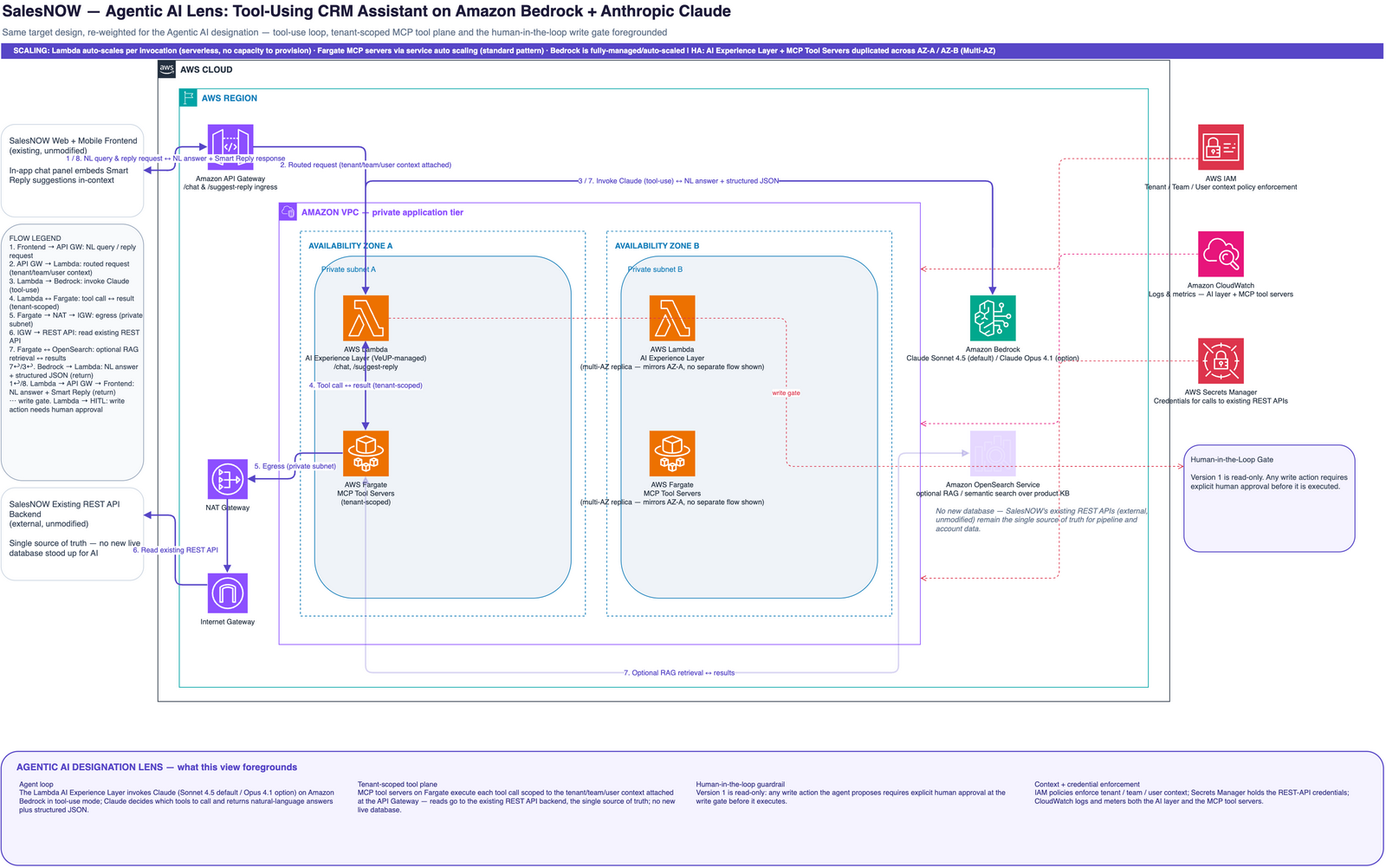
What VeUP designed for SalesNOW is an agent, not a canned Q&A feature: Anthropic Claude on Amazon Bedrock decides, per question, which MCP tool to call over SalesNOW's existing REST APIs, composes a grounded answer over the caller's own pipeline and account data, and stays strictly inside the caller's tenant, team, and user boundary — read-only, with a human in the loop for any write.
The challenge
A CRM assistant only earns its place if it can answer questions the interface can't anticipate — “which deals in my pipeline have gone quiet?”, “what should I say back to this customer?” — and in a multi-tenant SaaS every one of those answers is a potential isolation failure. The agentic problem is exactly that pairing: give a foundation model the freedom to choose tools and compose answers over live CRM data, while making it structurally impossible for any tool call, retrieval, or suggestion to cross a tenant, team, or user boundary. And the agent had to read from SalesNOW's existing backend as the single source of truth — no second live database standing beside the product.
The solution
VeUP's design puts Anthropic Claude on Amazon Bedrock at the center of a tool/data-access layer of Model Context Protocol (MCP) servers wrapping SalesNOW's existing REST APIs. The agent serves two endpoints inside the product — /chat for natural-language pipeline and account questions, /suggest-reply for Smart Reply — selecting the right MCP tool per intent and returning natural-language summaries with optional structured JSON, plus optional retrieval-augmented search over the product knowledge base. Tenant, team, and user context propagates through every layer — model, tool, retrieval — so isolation is a property of the architecture rather than a prompt convention. Claude Sonnet 4.5 and Claude Opus 4.1 are the named model options (backed by Sonnet 4.5), standardizing on Claude for reasoning and tool-calling from Bedrock's multi-provider catalog. Version 1 is read-only with a human in the loop for any write.
Design outcomes
| KPI | Result |
|---|---|
| Agent design | A documented tenant-isolated agentic architecture on Bedrock and Claude: the agent selects MCP tools and composes answers over the customer's own data, strictly scoped per tenant, read-only with a human in the loop for v1. Pilot numbers follow once the build ships — VeUP doesn't publish outcomes ahead of delivery. |
| Isolation posture | Tenant, team, and user context propagated through model, tool, and retrieval layers — no query, suggestion, or answer can cross a boundary by construction, and the existing REST APIs remain the single source of truth. |
| Lessons & continuation | Wrapping existing APIs as MCP tools is what keeps an in-app agent honest: the tool surface inherits the product's own authorization model instead of re-inventing it, and read-only-with-human-in-the-loop is the safe v1 posture for writes. POC and pilot delivery follow on a phased path from discovery through an in-app pilot. |