

A digital-signage SaaS moves 30-day to 1-year commitments on Amazon CloudFront
 Amazon CloudFront
 Amazon OpenSearch
 Amazon RDS
 Amazon CloudWatch
For Displai (formerly Raydiant), a digital-signage SaaS, VeUP ran a multi-region FinOps optimization across its AWS estate: the CloudFront Savings Bundle on delivery, long-lived instances moved off 30-day GRIs onto 1-year commitments, CloudWatch log-cost cuts, and an RDS extended-support fix.
The challenge
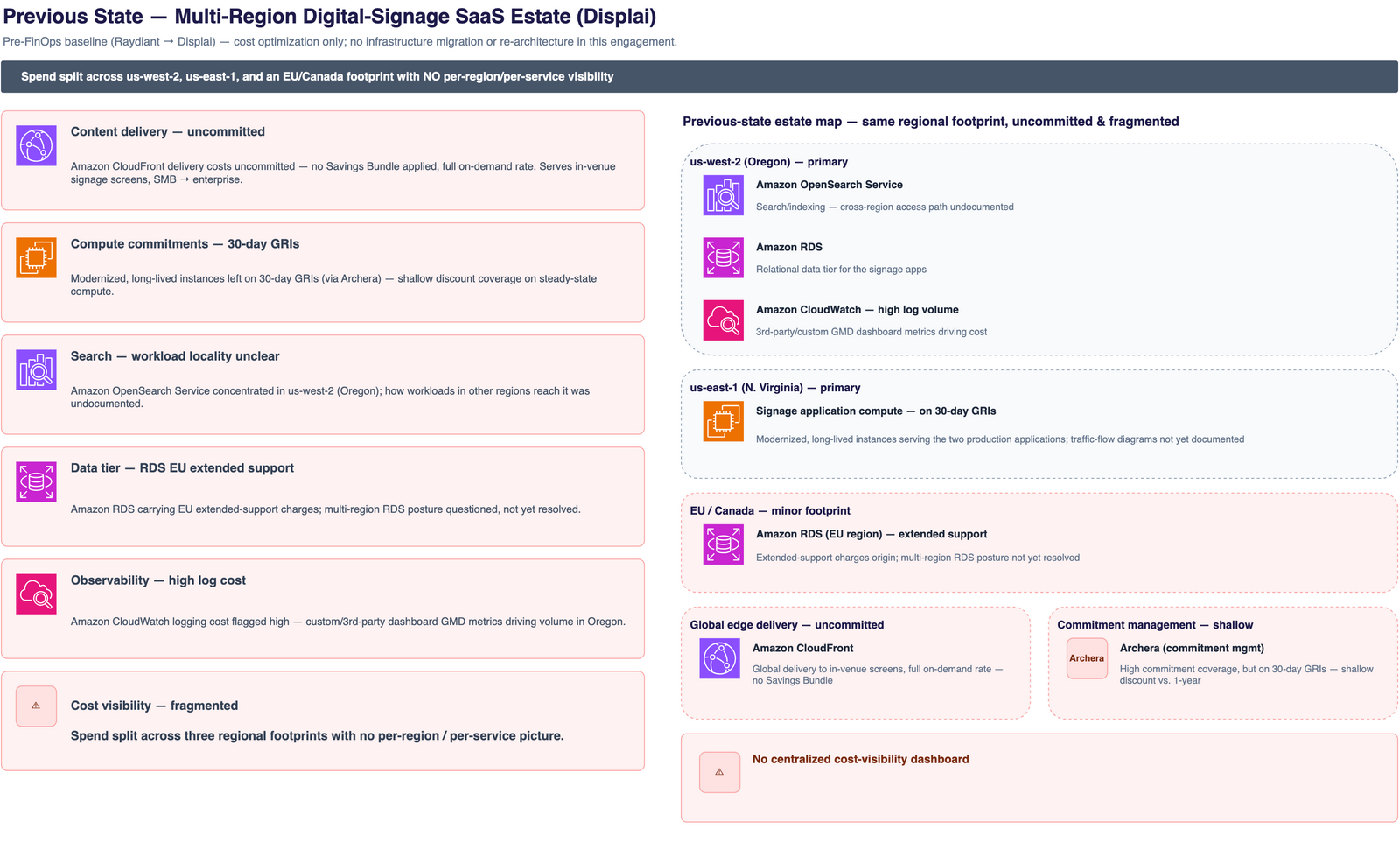
Displai (formerly Raydiant) runs an interactive digital-signage SaaS that turns in-venue TVs into connected media experiences for customers from SMB to global enterprise. Its product economics depend on efficient multi-region content delivery and storage, but spend was spread across us-west-2 (Oregon), us-east-1 (N. Virginia), and an EU/Canada footprint with no clear per-region/per-service picture: CloudFront delivery costs were uncommitted, modernized long-lived instances sat on 30-day GRIs, CloudWatch logging cost was high (custom/3rd-party dashboard metrics in Oregon), and RDS carried EU extended-support charges. The Raydiant -> Displai entity change also had to be handled mid-contract.
The solution
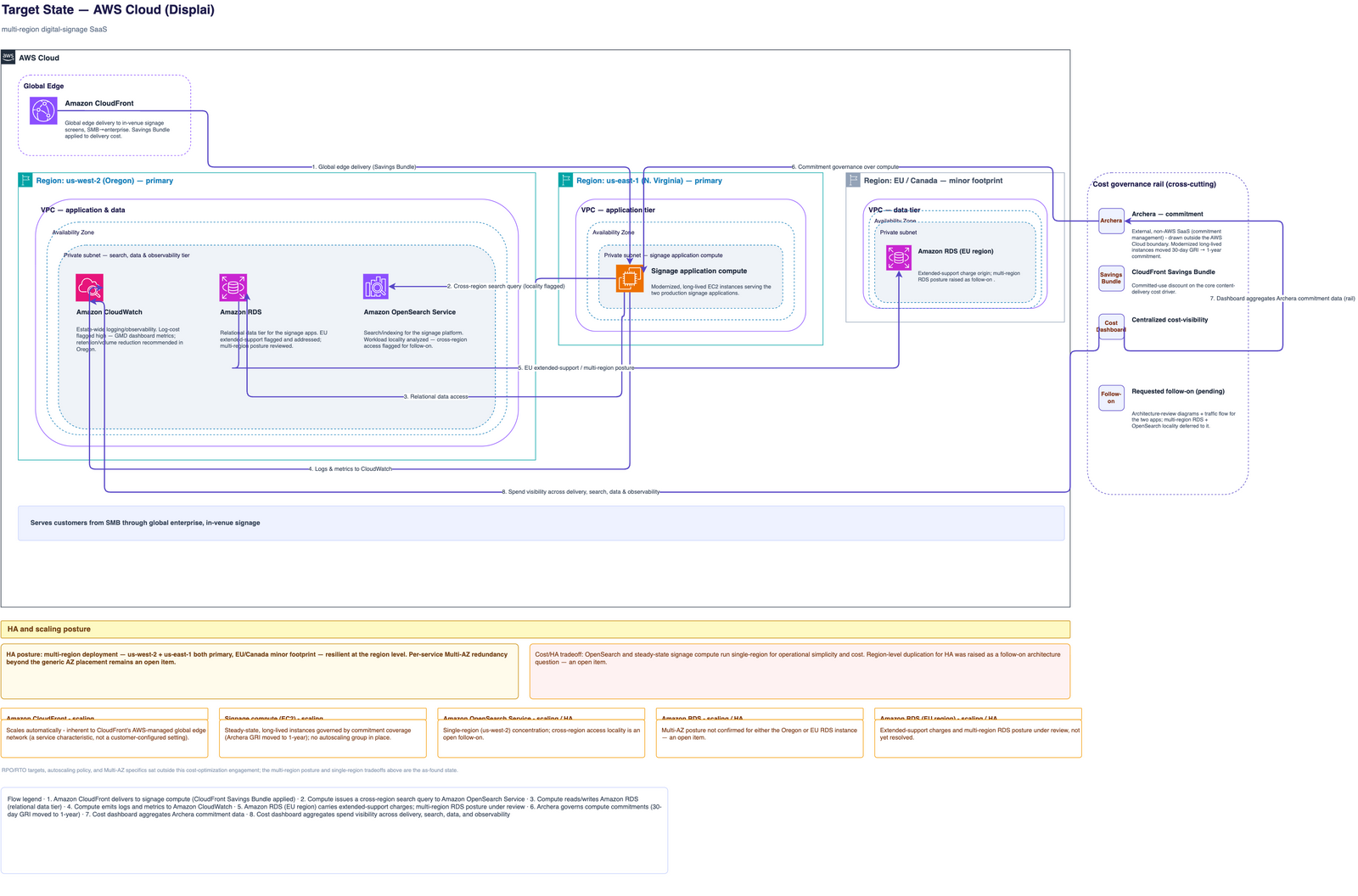
A multi-region digital-signage content-delivery platform on AWS, FinOps-optimized across its delivery, search, data, and observability tiers: Amazon CloudFront for global edge delivery of media to in-venue signage screens (CloudFront Savings Bundle applied), Amazon OpenSearch Service (concentrated in us-west-2) for search/indexing, Amazon RDS as the relational data tier, and Amazon CloudWatch for observability. VeUP started by giving Displai the thing it lacked — one clear picture of spend per region and per service, with Oregon and N. Virginia identified as the primary cost regions. From there the levers followed: the CloudFront Savings Bundle on delivery, CloudWatch log retention and volume trimmed in Oregon, the RDS EU extended-support charges dealt with, OpenSearch workload locality analyzed, and modernized long-lived instances moved off 30-day GRIs (Archera) onto 1-year commitments.
Architecture
The multi-region digital-signage estate — from the pre-FinOps baseline (uncommitted CloudFront delivery, 30-day GRIs, fragmented cost visibility) through to the production CloudFront edge, per-region OpenSearch/RDS/CloudWatch estate, and the Archera-managed cost-governance plane.
Production outcomes
| KPI | Result |
|---|---|
| Production outcomes | Displai now sees its multi-region spend clearly, per region and per service, with Oregon and N. Virginia identified as the primary cost regions. The CloudFront Savings Bundle went straight onto the core content-delivery cost driver; modernized long-lived instances were steered off 30-day GRIs onto 1-year commitments; CloudWatch log retention in Oregon was marked for cutback; the RDS EU extended-support charges were flagged and addressed; and OpenSearch workload locality was analyzed for the next round of savings. |
| Engagement window | The engagement began as a FinOps review spanning the Raydiant-to-Displai transition, and the optimization work is ongoing. |
| Cost / TCO posture | The FinOps review was the heart of the engagement: per-region, per-service spend mapping across the estate, the CloudFront Savings Bundle on delivery, commitment coverage modernized from 30-day GRIs to 1-year terms, CloudWatch log-source cost analysis, and the RDS extended-support review — every lever tied to protecting the content-delivery economics a signage platform lives on. |
| Lessons & continuation | For a multi-region signage media platform, establishing centralized per-region/per-service cost visibility is the precondition for every other lever; the CloudFront Savings Bundle is the direct reduction on the core delivery cost driver; modernized long-lived instances belong on 1-year commitments not 30-day GRIs; and high-cost custom/3rd-party dashboard log metrics are a recurring CloudWatch cost driver worth tuning. |